
How to travel the world in March without leaving Coimbra.

We all know something about geopolitical realities, but since the documentaries, which you will have a chance to see during the festival, add depth, we can see and try to understand the real struggle, and how others feel in their own realities around the world.
How to travel the world in March without leaving Coimbra.

When you come to live in Coimbra, only with a suitcase and skills, you have two options. Count on what's already here, that your skills will be useful, and maybe you'll find your people, or you can create something that will bring your people to you. Two years after Leandro Cordeiro came to Coimbra, who holds many job titles in the film industry, had a bold idea.

Having worked more than 10 years in the Brazilian film industry, he was part of its vibrant community, but here he knew nobody. Instead of waddling his path in the new hometown, he decided to create a film festival to enter the Portuguese film industry through its backdoor. At that time there was only one festival in Portugal, in Lisbon. Solely focused on Portuguese cinema, they missed a huge opportunity. When Leandro noticed it, he aimed exactly there–he looked outwards, he searched for international nonfiction. "I have no appetite for fiction at all," he admits, "I think it is way easier to talk about human rights with documentaries." Since his degree in cinema studies at UNISUL University, he has worked almost only with documentaries: as a film director, sound engineer, and festival producer. After he finished listing the documentaries he worked on and its topics–music and culture, deforestation issues, and challenges faced by Indigenous Peoples–he explained that because Brazil is like a huge pot of diverse culture full of remarkable characters, it pressure-cooks unique stories, endlessly, stories that are better than fiction.

When I came to his studio–located between prison, military barracks, and a Christian foundation providing temporary shelter–to talk about the festival, he bent over a white cylinder resembling a kitchen-sized rubbish bin. The dehumidifier fits perfectly with the Yamaha studio monitors HS series and a white Arturia 61 MIDI controller on his desk. It reduces humidity from 85% to 60%, and that is good for the music equipment, he said proudly, "The air feels fresh now." He spends most of his working time in this basement, and he was busy with the leaflet design for this year's festival edition.
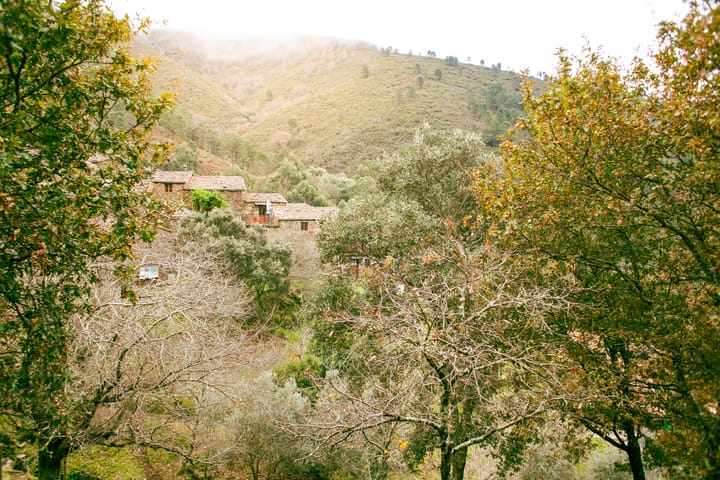
Leandro was born in Lapa in Paraná state, a small, poor German colony in the south in which people are "unable to speak their feelings," he told me. There is a misconception about the Brazilians: people think they are like a "latino americano", that they are always happy, very expressive. But Brazil is huge, with a lot of colonies(still!) in remote areas where people use only their mother tongue. Russians, Italians, Ukrainians, Germans, and Poles came in the 19th century, and then, because of the two world wars, were joined by more fellow countrymen and women with a christian-conservative background, so they never integrated with the Brazilian culture. As a result of growing up in the small, confined community, Leandro made his personal journey about finding the emotional side of himself. He started making music and then music for film. After he won a scholarship, he left his family and friends and moved out to study cinema for 4 years. And while studying, he was working as a sound engineer and editor.

The first edition of DOC Coimbra was a drag to organize. Leandro and Jonas Amarante, the second co-founder, had no funding to get the venues they would like to, to get the screening equipment, to do the marketing. "Being Brazilian and asking for a venue without the funding was very hard". Nobody wanted to talk to him, except the Atelier A Fábrica. They agreed to launch the festival under their roof with exposed wooden beams and OSB sheeting, and having a bar inside, Leandro smirked, they made it possible for people to watch movies while sipping beer (or coffee)–a true underground experience. The Atelier A Fábrica wasn't appropriate for the film festival, though; Leandro shakes his head as if to say a hard no–it's more of a concert hall. But by talking the DOC in, they opened a screen for 195 submissions, 21 selected movies, and more than 200 visitors. In that moment Leandro dived behind a sofa in his studio, a small bedroom-sized room, to fish out a transparent plastic document pouch. With pride, he showed me a weathered leaflet with the first edition’s program.

While the first edition had an underground vibe, the third, the 2026 one, welcomes 727 submissions, from which 60 movies are selected and will be screened in 4 venues over six days. "Year by year we're growing in quality and in size," Leandro said, and having taken his glasses off, he closed his eyes and erased his face–probably while remembering all the movies he had to watch. He and the other 8 curators like to see strong characters, archival films, and "different kinds of narratives," he said, "when the films aren't based only on interviews and the filmmaker tries to create another way to tell stories."

"We believe every film is political." The best stories, though, show internal and external conflict side by side. Even if the film comes from a war zone, like Ukraine and Palestine, there will always be a protagonist who feels and shows their own vulnerabilities. We all know something about geopolitical realities, but since the documentaries, which you will have a chance to see during the festival, add depth, we can see and try to understand the real struggle, and how others feel in their own realities around the world. "How another person of my age lives, say, in Kyrgyzstan, and where they go to school, and what they eat, and how they suffer," recited Leandro.

Most films screened during the festival are premieres, and because a lot of films have no distribution and minimal budgets, they probably neither will be shown in Portugal again nor on a streaming platform.

As soon as I stopped recording, Leandro said, "Ok! Let's go and eat." It was time for lunch.

The DOC. Coimbra film festival will run between 17th and 22th of March.